
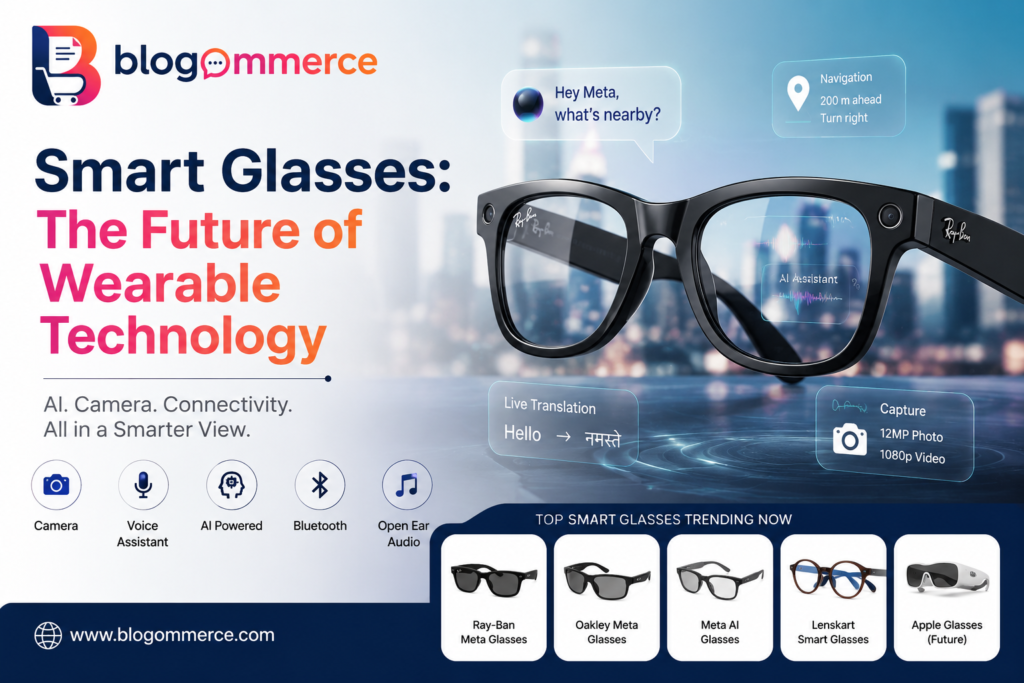
Technology is becoming more integrated into the way we work, communicate, travel, exercise, and enjoy entertainment. One of the most exciting developments in wearable electronics is the rise of smart glasses. Unlike traditional eyewear, smart glasses can combine cameras, microphones, speakers, connectivity, and artificial intelligence into a familiar glasses-style design.
From Ray-Ban Meta glasses and Meta AI glasses to performance-focused Oakley Meta models, the technology is moving beyond simple notifications and toward hands-free computing. Meta describes its AI assistant as being available through AI glasses, allowing users to get information, translate, and interact with the world without constantly reaching for a phone.
What Are Smart Glasses?
Smart glasses are wearable devices designed to look and function like conventional glasses while adding digital features. Depending on the model, they may include cameras, microphones, open-ear speakers, voice controls, Bluetooth connectivity, AI assistants, and augmented-reality capabilities.
Some models are primarily designed for audio and photography, while future AR glasses are expected to provide more visual information directly within the user’s field of view.
This makes smart glasses an important part of the growing wearable technology industry.
Ray-Ban Meta Glasses: A Major Step in Smart Eyewear
One of the best-known examples of modern smart eyewear is Ray-Ban Meta glasses. The concept combines the familiar Ray-Ban eyewear experience with Meta’s technology.
These Meta glasses are designed around hands-free interaction, allowing users to capture photos and videos, listen to audio, communicate, and use Meta AI through voice commands.
Meta has continued expanding its AI capabilities for glasses, positioning AI eyewear as a way to access information and assistance without taking out a smartphone.
For consumers searching for Meta glasses price, it is important to check the exact model, lens configuration, country, and retailer because prices can vary significantly. Similarly, searches for Meta glasses price in India may show different prices depending on availability, taxes, import costs, and official distribution.
Meta AI Glasses and Artificial Intelligence
The biggest difference between conventional camera eyewear and newer Meta AI glasses is artificial intelligence.
Instead of simply taking pictures, AI-enabled glasses can connect visual information with voice-based assistance. Users can ask questions, interact with an AI assistant, and perform certain tasks without constantly using a phone.
Meta’s current AI ecosystem supports features such as answering questions, translation, and understanding visual information.
This creates a new category of AI wearable technology, where the device becomes an interface between the user and the digital world.
Camera Glasses: More Than Just Photography
Another important category is camera glasses. These glasses contain integrated cameras that allow users to capture photos or video from their point of view.
Camera eyewear can be useful for:
- Travel and tourism
- Outdoor activities
- Sports
- Content creation
- Family events
- Hands-free documentation
- First-person video recording
Modern products are making camera glasses more practical by combining cameras with microphones, speakers, connectivity, and AI.
For example, Oakley Meta models include hands-free cameras and open-ear audio. Oakley lists a 12MP camera on its HSTN models, while its Vanguard performance model uses an ultra-wide 12MP camera for first-person capture.
Oakley Meta: Smart Glasses for Active Lifestyles
The partnership between Meta and Oakley demonstrates how smart glasses are expanding beyond everyday eyewear.
Oakley Meta models are designed with a stronger focus on sports and outdoor activities. Features can include open-ear audio, cameras, Meta AI, hands-free communication, and integration with fitness platforms.
Oakley’s performance-focused Meta glasses include features such as navigation, live translation, AI assistance, and sports integrations.
The Oakley Meta Vanguard, for example, is designed for athletes and includes a 12MP camera, Meta AI features, open-ear speakers, and water and dust resistance.
This shows how Oakley is helping bring smart eyewear into sports and performance environments.
AR Glasses: The Next Stage of Wearable Technology
While today’s smart glasses can provide audio, photography, AI assistance, and communication, AR glasses represent a potentially larger technological shift.
Augmented reality glasses can overlay digital information onto the physical world. Instead of looking down at a smartphone, users could potentially see:
- Navigation directions
- Notifications
- Translated text
- Product information
- Work instructions
- Real-time data
- Educational information
The long-term vision for AR glasses is to make digital information feel like a natural part of the user’s environment.
What About Glasses With Text?
The phrase glasses with text generally refers to smart eyewear that can display information directly in or near the user’s field of vision.
This is an important distinction. Many current AI glasses provide information through audio rather than displaying text on the lens. More advanced AR and display-based glasses could eventually provide visual information directly to the wearer.
This technology could have applications in navigation, education, healthcare, manufacturing, logistics, and professional training.
Camera Sunglasses and Smart Eyewear
The concept of camera sunglasses is also gaining attention. These products combine the appearance and functionality of sunglasses with integrated cameras and smart features.
For outdoor users, this can be particularly attractive because the glasses can provide eye protection while also offering hands-free recording and audio.
However, users should consider privacy when using any wearable with a camera. Responsible use includes respecting other people’s privacy and following applicable laws and venue rules.
Could Apple Glasses Change the Market?
Another frequently searched term is Apple glasses. Apple has not announced a consumer smart-glasses product under that name, so consumers should be cautious about online claims presenting unannounced products as officially available.
Nevertheless, Apple’s broader work in spatial computing has increased interest in what future lightweight Apple eyewear could look like. If Apple eventually enters the smart-glasses category, competition could accelerate innovation across AI, AR, displays, battery technology, and wearable computing.
Lenskart Smart Glasses and the Indian Market
India is also becoming an important market for smart eyewear. Searches for Lenskart smart glasses reflect growing consumer interest in combining fashionable eyewear with technology.
For Indian consumers, factors such as price, warranty, prescription-lens availability, smartphone compatibility, after-sales service, and local availability can be just as important as technical specifications.
When comparing products, buyers should look beyond the headline Meta glasses price in India and evaluate the complete ownership experience.
Key Features to Look for in Smart Glasses
If you are considering buying smart glasses, look for the following features:
1. Camera Quality
For camera glasses, image and video quality are important. Consider resolution, stabilization, field of view, and recording controls.
2. AI Capabilities
AI can make smart glasses considerably more useful. Look for voice assistance, visual understanding, translation, and other functions supported in your region.
3. Audio Quality
Open-ear speakers can allow users to listen to music and calls while remaining aware of their surroundings.
4. Battery Life
Battery performance is critical because cameras, microphones, wireless connectivity, and AI features consume power.
5. Comfort
Smart glasses should remain comfortable during extended use. Frame weight, lens options, nose fit, and temple design can make a significant difference.
6. Privacy
Camera-equipped eyewear should have clear recording indicators and responsible privacy controls.
7. Smartphone Compatibility
Many smart glasses require a compatible smartphone and companion application. Oakley Meta, for example, requires a smartphone, Meta account, Meta AI app, and supported operating system.
The Future of Smart Glasses
The future of smart glasses is likely to be shaped by artificial intelligence, augmented reality, better batteries, smaller components, improved cameras, and more natural voice interaction.
Today’s Meta smart glasses demonstrate how traditional eyewear can become an AI-powered interface. Meanwhile, Oakley Meta shows how the same technology can be adapted for sports and outdoor use.
Future generations could move further toward true AR glasses, providing visual information, real-time translation, navigation, contextual assistance, and personalized digital experiences.
As the technology develops, smart glasses may become less like gadgets and more like everyday computing devices.
Conclusion
Smart glasses are emerging as one of the most exciting areas of wearable technology. Products such as Ray-Ban Meta glasses, Meta AI glasses, and Oakley Meta demonstrate how cameras, audio, connectivity, and artificial intelligence can be integrated into everyday eyewear.
Although features and availability vary between products and markets, the direction is clear: computing is becoming increasingly hands-free.
From smart glasses and camera sunglasses to future AR glasses and glasses with text, the next generation of wearable electronics could change how people interact with information and technology.
For consumers in India, researching Meta glasses price in India, available models, features, warranty, compatibility, and after-sales support is essential before making a purchase. As AI and augmented reality continue to evolve, smart eyewear could become one of the defining technologies of the next generation of wearable electronics.
Read Our Previous Blog : https://blogommerce.com/ai-data-centers-in-india/
Follow Us On Instagram : Blogommerce