
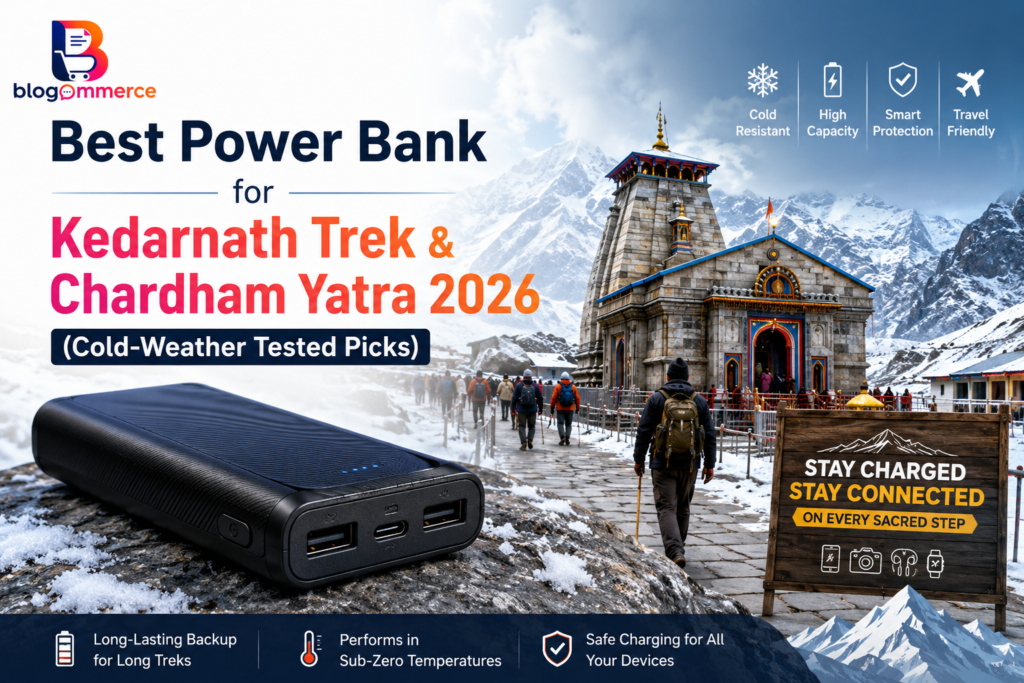
Quick answer: For most trekkers, a 20,000mAh power bank with 18–22.5W fast charging is the sweet spot for the Kedarnath trek — enough for 2–3 days without a charging point, light enough for a 16 km uphill walk, and within airline cabin-baggage limits. If you’re doing a longer, remote leg of the Chardham Yatra, step up to a rugged 20,000–25,000mAh pack and carry a smaller 10,000mAh backup.
Every Kedarnath packing list tells you to “carry a power bank.” Almost none tell you which one, what capacity actually survives sub-zero mountain nights, or how much charge you really lose in the cold. This guide fixes that.
Why a Regular Power Bank Isn’t Enough at Altitude
Kedarnath sits at roughly 3,583 metres, and even in peak season, night temperatures can drop close to freezing. That matters more than most packing lists admit: lithium-ion batteries lose usable capacity in the cold, and testing from outdoor gear reviewers has shown drops of anywhere from 8% to over 20% efficiency loss in freezing conditions, depending on the power bank’s build quality.
In practice, this means:
- A 20,000mAh bank may only deliver 10,000–14,000mAh of real, usable charge at altitude.
- Charging speed slows down in the cold, so fast-charging specs (like 22.5W) perform closer to standard speeds.
- Charging points on the trek route are rare to non-existent between Gaurikund and Kedarnath — you’re on your own once you start walking.
The fix isn’t complicated: buy slightly more capacity than you think you need, and keep the power bank warm (inside a jacket pocket, not the outer mesh of your backpack).
TL;DR — Best Picks at a Glance
| Power Bank | Capacity | Best For | Fast Charging | Approx. Price (India) |
|---|---|---|---|---|
| Xiaomi (Mi) 4i 20000mAh | 20,000mAh | Best overall value | 33W Type-C PD | ₹1,800–₹2,200 |
| Ambrane 20000mAh 22.5W | 20,000mAh | Rugged build, drop resistance | 22.5W | ₹1,400–₹1,800 |
| URBN Nano 20000mAh | 20,000mAh | Compact, fits daypack pockets | 22.5W | ₹1,600–₹2,000 |
| Amazon Basics 20000mAh | 20,000mAh | Reliable budget backup | 18W | ₹1,200–₹1,600 |
| Ambrane PowerLit 100W | 25,000mAh | Group treks, charging laptops/multiple devices | 100W PD | ₹2,800–₹3,500 |
Prices fluctuate with sales (June and October windows typically see the best deals on Indian platforms). Always check current listings before buying the best power bank for Kedarnath trek
Detailed Picks
1. Xiaomi (Mi) 4i 20000mAh — Best Overall for the Trek
The 33W Type-C Power Delivery output means faster top-ups when you do reach a charging point in Sonprayag or Guptkashi. Triple output ports (2 USB-A + 1 Type-C) let you charge a phone and a headlamp or earbuds together. Solid polycarbonate build handles the inevitable bumps against rocks and trekking poles.
Good for: Solo trekkers and pilgrims who want one reliable bank without carrying a backup.
2. Ambrane 20000mAh 22.5W — Best Rugged Build
Ambrane’s power banks are known for a thicker, more drop-resistant shell — genuinely useful on a trail with rocky, uneven sections. 22.5W fast charging via Type-C PD plus Quick Charge 3.0 support on USB-A.
Good for: Trekkers worried about drops on the 16–18 km Gaurikund–Kedarnath stretch.
3. URBN Nano 20000mAh — Best for Pack Weight
If your daypack space is tight, URBN’s Nano line packs 20,000mAh into a near credit-card-width footprint. Still delivers a full 22.5W output despite the compact size.
Good for: Trekkers optimizing for pack weight and pocket space over raw ruggedness.
4. Amazon Basics 20000mAh — Best Budget Backup
No frills, no OLED display, but consistent voltage output and a proven track record. A sensible choice as a second, backup power bank rather than your only one.
Good for: Carrying alongside a primary power bank for multi-day Chardham circuits.
5. Ambrane PowerLit 100W (25,000mAh) — Best for Groups
100W PD output can charge a laptop or tablet, not just phones — useful if you’re travelling with family, documenting the yatra for content, or splitting charging duties across a group. Heavier, so weigh this against your total pack weight.
Good for: Group Chardham Yatra trips, content creators, or helicopter-yatra travelers packing lighter overall (see weight-limit note below).
What Actually Matters When Buying (Beyond mAh)
Capacity (mAh): 20,000mAh is the practical sweet spot — enough for 2–3 days of phone + headlamp + camera use, without being so heavy it strains your shoulders on the uphill stretch. Remember: due to voltage conversion loss, a 20,000mAh bank typically delivers 13,000–14,000mAh of real charge even before cold-weather loss is factored in.
Fast charging (PD/QC): Useful when you do find a charging point, but don’t overweight this — cold temperatures slow down fast-charging performance regardless of the spec sheet.
Build and port type: Prefer Type-C input/output — most current phones, action cameras, and GPS devices have moved to Type-C, and it charges faster than Micro-USB.
Safety certification: Look for BIS certification (mandatory for power banks sold in India) plus overcharge and short-circuit protection. Avoid unbranded sub-₹500 “high capacity” listings — genuinely reliable cells at that price point don’t exist.
Weight vs. capacity trade-off: On a 16–18 km uphill trek, every extra 100g matters. A 20,000mAh bank (roughly 350–450g) is generally the ceiling most trekkers should carry unless doing a helicopter yatra with a hard baggage cap.
Special Note: Helicopter Yatra Baggage Limits
If you’re taking the helicopter option for Kedarnath, note that the baggage weight limit is typically 5 kg per passenger, with soft duffel bags only — no hard-shell cases. Factor your power bank’s weight into that limit, and consider a single 20,000mAh bank rather than carrying a primary-plus-backup setup.
For domestic flights to Dehradun or Jolly Grant airport en route, power banks are cabin-baggage-only items and must stay under the standard 100Wh (roughly 27,000mAh) limit — never pack them in checked luggage, as security will remove them.
How to Keep Your Power Bank Alive in the Cold
- Store it close to your body — an inner jacket pocket keeps it warmer than an outer backpack pocket.
- Charge devices in short bursts rather than letting the power bank run continuously in freezing air.
- Turn on airplane mode on your phone when not actively navigating — searching for signal in remote stretches drains battery fast and forces more frequent charging.
- Charge the power bank itself fully the night before you start trekking, ideally indoors at room temperature.
Frequently Asked Questions :-
Ques 1.What mAh power bank is best for the Kedarnath trek? A 20,000mAh power bank is the practical choice for most trekkers — it balances real-world usable charge (after cold-weather and conversion losses) against the extra weight of carrying it uphill for 16–18 km.
Ans 1. Can I carry a power bank on the Kedarnath helicopter yatra? Yes, but baggage limits are typically capped around 5 kg per passenger with soft bags only. Choose one compact 20,000mAh bank rather than multiple units to stay within the limit.
Ques 2. Do power banks work properly in Kedarnath’s cold weather? They work, but with reduced efficiency — expect roughly 8–20% less usable capacity in near-freezing temperatures. Keeping the power bank in an inner jacket pocket instead of an outer bag pocket helps minimize this loss.
Ans 2. Is a solar power bank better for the Kedarnath trek? Not usually. Solar charging is slow, weather-dependent, and unreliable on a short 1–2 day trek. It’s more useful for longer, multi-day Himalayan treks with extended time away from any charging point.
Which is better for Chardham Yatra — one large power bank or two smaller ones? For circuits longer than the Kedarnath leg alone (covering Yamunotri, Gangotri, and Badrinath too), carrying a primary 20,000mAh bank plus a smaller 10,000mAh backup gives redundancy if one unit fails or runs low between charging stops.
Planning the rest of your Kedarnath or Chardham packing list? Check out our complete travel and trekking essentials guide for clothing, gear, and documents to carry alongside your power bank.
MORE BLOG : https://blogommerce.com/best-power-bank-deals-online/
FOLLOW US ON INSTAGRAM : BLOGOMMERCE