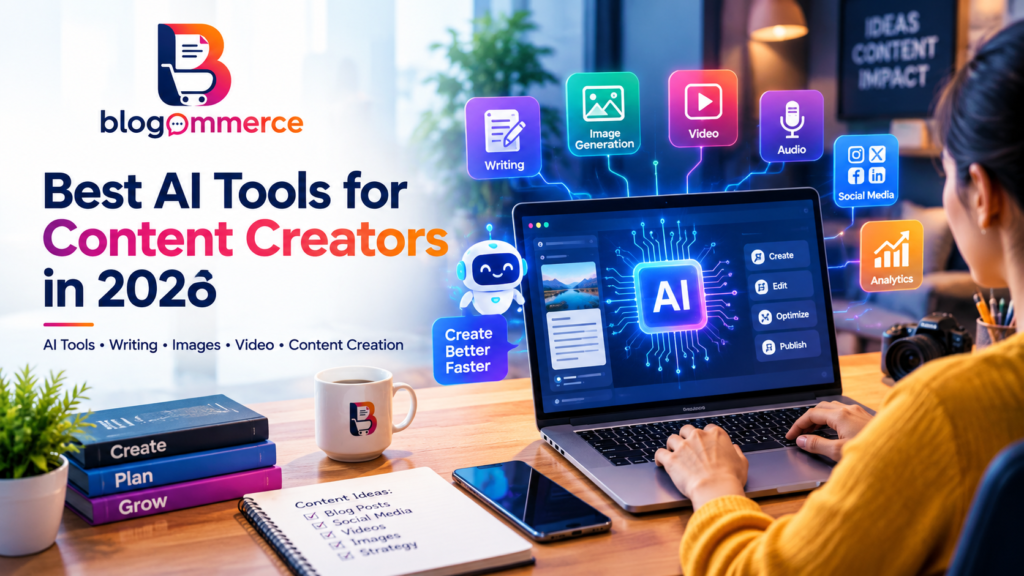
Artificial intelligence has transformed the way content is created, edited, optimized, and distributed. From writing blog posts and social media captions to generating images, videos, presentations, and marketing ideas, AI tools are helping content creators save time and improve productivity.
In 2026, there are more artificial intelligence tools available than ever before. However, choosing the right tool can be challenging because different AI platforms are designed for different purposes.
This guide explores the best AI tools for content creators in 2026, explains what are AI tools, discusses different categories, and provides a practical AI tools list for writers, marketers, bloggers, designers, YouTubers, and social media creators.
What Are AI Tools?
AI tools are software applications or online platforms that use artificial intelligence technologies to perform tasks that traditionally require human effort. These tasks can include writing, research, image generation, video editing, audio creation, data analysis, translation, and content optimization.
If you are wondering what is AI tools, the simple answer is that they are applications powered by AI models that can understand instructions, process information, generate content, and assist users with creative or professional tasks.
Modern AI tools can help content creators:
- Generate content ideas
- Write and rewrite content
- Create blog outlines
- Generate images
- Edit videos
- Produce voiceovers
- Create presentations
- Improve grammar
- Optimize content for search engines
- Create social media posts
- Summarize research
- Automate repetitive tasks
Why Are AI Tools Important for Content Creators?
Content creators need to produce high-quality content consistently. Researching topics, writing scripts, creating graphics, editing videos, and promoting content can take many hours.
The right AI tools can make these processes more efficient.
Some important benefits include:
1. Faster Content Creation
AI can help generate initial drafts, outlines, headlines, captions, and content ideas quickly. Creators can then review, edit, and personalize the content.
2. More Content Ideas
When creators experience writer’s block, AI can provide topic ideas, questions, headlines, content angles, and creative concepts.
3. Improved Productivity
Instead of spending hours on repetitive tasks, creators can use AI to automate parts of their workflow.
4. Support for Multiple Content Formats
Different AI tools can assist with blogs, videos, images, podcasts, social media posts, presentations, emails, and advertisements.
5. Better Content Optimization
AI-powered platforms can help analyze content and suggest improvements for readability, SEO, headlines, keywords, and engagement.
Best AI Tools for Content Creators in 2026
There are many different AI tools available today. The best option depends on the type of content you create and the tasks you want to automate.
1. ChatGPT – AI Writing and Brainstorming
ChatGPT is a versatile AI assistant that can help content creators with research planning, brainstorming, writing, rewriting, summarization, content outlines, scripts, and marketing ideas.
Bloggers can use it to create article structures and develop ideas, while social media managers can use it for captions and content calendars.
Best for: Writing, brainstorming, research assistance, scripts, and content planning.
2. Claude – Long-Form Content Assistance
Claude is an AI assistant that can be useful for analyzing large amounts of text, organizing information, brainstorming, and working on long-form content.
Content creators can use it to review documents, develop outlines, refine writing, and summarize information.
Best for: Long-form writing, document analysis, and content refinement.
3. Google Gemini – Research and Content Ideas
Google Gemini can assist creators with brainstorming, writing, research-oriented tasks, summarization, and productivity workflows.
It can be particularly useful for creators who already work extensively with Google’s ecosystem.
Best for: Brainstorming, research assistance, writing, and productivity.
4. Canva – AI Design and Visual Content
Canva combines graphic design capabilities with AI-powered features. Content creators can use it to create social media graphics, presentations, thumbnails, posters, advertisements, and other visual assets.
It is especially useful for creators who want to produce professional-looking designs without advanced graphic-design skills.
Best for: Social media graphics, presentations, thumbnails, and marketing visuals.
5. Adobe Firefly – AI Image Creation
Adobe Firefly provides generative AI capabilities for creating and modifying visual content.
Creators can use generative AI to explore visual concepts, create design elements, and experiment with different creative directions.
Best for: AI-generated images, creative design, and visual edit
6. Midjourney – Creative AI Images
Midjourney is widely used for generating creative and visually detailed images from text prompts.
It can be useful for concept art, creative campaigns, illustrations, thumbnails, and visual inspiration.
Best for: Creative images, illustrations, concept art, and visual experimentation.
7. Runway – AI Video Creation
Video creators can use AI-powered video platforms such as Runway to experiment with generative video, visual effects, editing, and other creative workflows.
AI video technology is becoming increasingly useful for creators who need to produce engaging visual content.
Best for: AI video generation and creative video production.
8. CapCut – AI Video Editing
CapCut provides a range of video editing features designed for short-form and social media content.
Its AI-assisted features can help creators with editing, captions, effects, and other video-production tasks.
Best for: YouTube Shorts, Instagram Reels, TikTok-style videos, and social media editing.
9. Descript – AI Audio and Video Editing
Descript approaches video and audio editing through text-based workflows. Creators can edit spoken content similarly to editing a document.
This can make it useful for podcasts, interviews, video tutorials, and other spoken-content formats.
Best for: Podcasts, interviews, video editing, and transcription-based workflows.
10. ElevenLabs – AI Voice Generation
ElevenLabs provides AI-powered voice and audio generation capabilities. Content creators can use AI voices for narration, video projects, educational content, and other applications where synthetic voice generation is appropriate.
Best for: Voiceovers, narration, and audio content.
AI Tools List by Content Type
If you are looking for a practical list of AI tools, it is helpful to organize them according to the type of content you create.
For Blog Writers
- ChatGPT
- Claude
- Google Gemini
- Grammarly
- AI SEO platforms
For Graphic Designers
- Canva
- Adobe Firefly
- Midjourney
- Adobe’s AI-powered creative tools
For YouTubers and Video Creators
- Runway
- CapCut
- Descript
- AI video-generation platforms
For Podcasters
- Descript
- ElevenLabs
- AI transcription tools
- AI audio-editing platforms
For Social Media Creators
- Canva
- ChatGPT
- CapCut
- AI image-generation platforms
- AI content-planning tools
Different AI Tools for Different Tasks
One important thing to understand is that there is no single AI tool that is perfect for every content-creation task.
For example, a writer may need an AI writing assistant, while a graphic designer may require an AI image generator. A YouTuber may need AI video-editing software, while a podcaster may need AI transcription and voice tools.
This is why understanding the different AI tools available can help you build a more efficient content workflow.
A typical workflow could look like this:
Idea Generation → Research → Writing → Editing → Graphic Creation → Video Production → SEO Optimization → Publishing
AI can assist at almost every stage of this process.
How to Choose the Best AI Tools in 2026
When comparing the best AI tools, content creators should consider more than popularity.
1. Identify Your Content Type
First determine whether you primarily create blogs, videos, images, podcasts, social media content, or presentations.
2. Check Features
Compare the features offered by each tool and determine whether they match your workflow.
3. Consider Ease of Use
A tool with advanced features may not be useful if it is difficult to operate. Choose software that fits your technical experience.
4. Review Pricing
Many AI platforms offer free versions, trials, or paid plans. Check the available features and usage limitations before selecting a subscription.
5. Consider Output Quality
AI-generated content should always be reviewed. Look for tools that produce useful results while allowing you to edit and customize the final output.
6. Check Privacy and Data Policies
Before uploading confidential documents, customer information, or proprietary material, review the platform’s privacy and data-handling policies.
How to Use AI Responsibly for Content Creation
AI can significantly improve productivity, but it should support human creativity rather than completely replace it.
Content creators should:
- Fact-check important information.
- Review AI-generated text before publishing.
- Add original insights and experiences.
- Avoid publishing repetitive or low-value content.
- Check copyright and licensing requirements.
- Protect confidential information.
- Maintain a consistent brand voice.
- Edit AI-generated content for accuracy and quality.
Human creativity, expertise, and editorial judgment remain important even when using advanced artificial intelligence tools.
Future of AI Tools for Content Creators
The AI industry continues to develop rapidly. Future AI tools are expected to become increasingly integrated across writing, design, video, audio, marketing, and publishing workflows.
Instead of using one application for every task, creators may increasingly build interconnected AI workflows where several specialized tools work together.
For example, a creator could develop an idea with an AI assistant, create a script, generate visual concepts, produce video assets, create a voiceover, optimize the content, and prepare social media posts using multiple AI applications.
This makes learning how to evaluate and use AI tools an important skill for modern content creators.
Final Thoughts
The growing number of AI tools in 2026 gives content creators more opportunities to work efficiently and experiment with new formats. From AI writing assistants and image generators to video editors and voice-generation platforms, there are different AI tools for almost every stage of the creative process.
If you are building your own AI tools list, start with the tools that solve your biggest content-production challenges. Rather than choosing a tool simply because it is popular, evaluate its features, quality, usability, pricing, and suitability for your workflow.
Used thoughtfully, artificial intelligence tools can help creators spend less time on repetitive tasks and more time developing original ideas, engaging audiences, and producing valuable content.
Read Our Previous Blogs :- https://blogommerce.com/best-tourist-places-in-india/
FOLLOW US ON INSTAGRAM :- BLOGOMMERCE